Six flat cats showed up in a vacant lot in Cape Coral, Florida, and I have not been able to stop thinking about them since.
They’re cutouts. Two-dimensional cat effigies staked into the dirt of an empty lot on Southwest 25th Place, facing outward like the world’s least convincing neighborhood watch. A second batch turned up on another empty lot a few blocks away. Nobody has come forward to claim either set, which is somehow the most Florida detail in a story already stuffed with them.
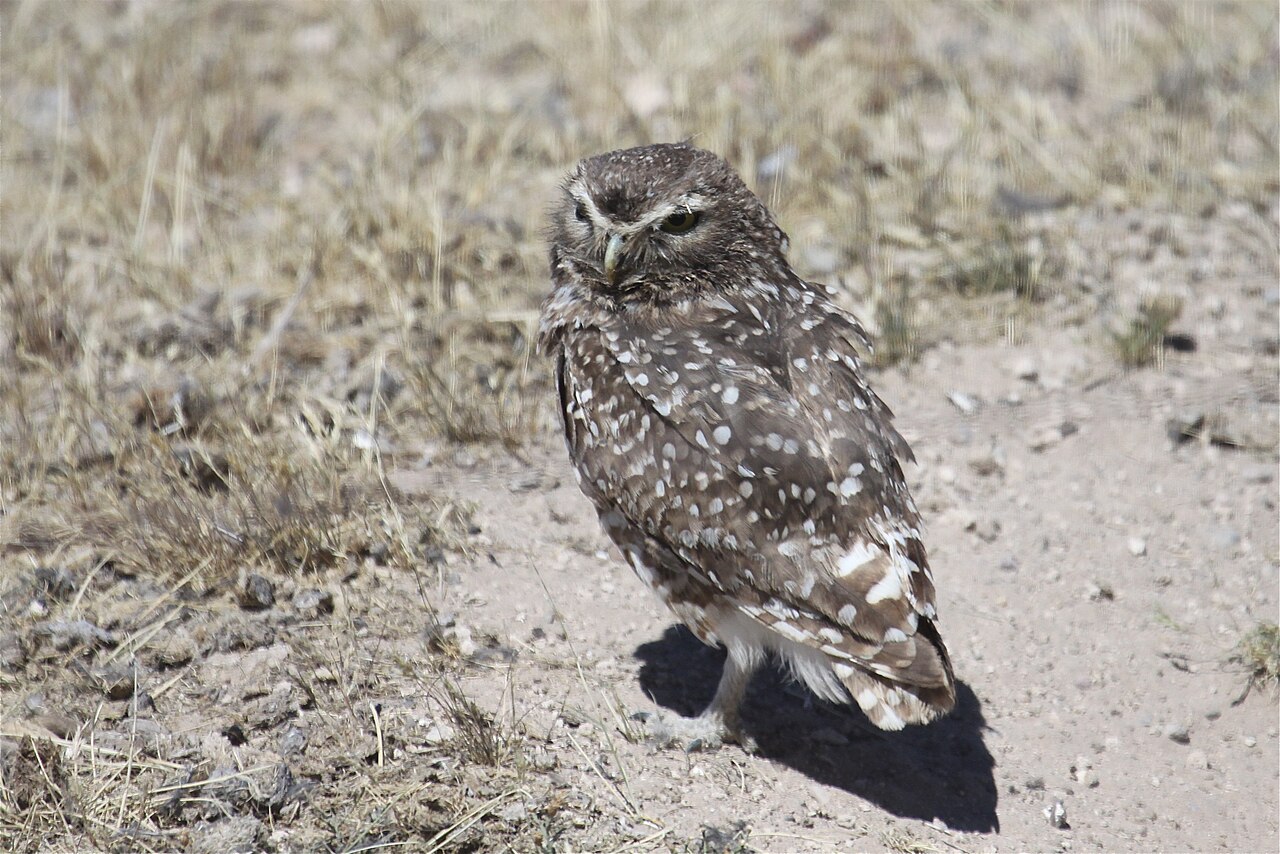
Wildlife volunteers have a theory and it holds up. Both lots recently changed hands. Burrowing owls love exactly this kind of ground, flat and sandy with nothing built on it yet, and once one of those birds digs in your empty lot stops being yours in any practical sense. Burrowing owls are protected under the federal Migratory Bird Treaty Act and listed as threatened by the state of Florida. You can’t disturb an active burrow without a permit. Your construction timeline now answers to a nine-inch bird with yellow eyes.
So somebody ran the numbers on permitting delays versus a trip to the print shop, and the print shop won.
I want to be angry about this. Mostly I’m impressed by the sheer nerve. The reasoning is that cats prey on burrowing owls, which is true of actual cats, and therefore an owl scouting a lot for real estate will spot six pieces of weatherproofed cardboard and decide to keep flying. That is an enormous amount of faith to place in a bird’s inability to notice that a predator has never once moved or smelled like anything.
Owls aren’t stupid. These particular birds nest along airport fences and behind Little League outfields. They hold their ground against dogs. A Cape Coral burrowing owl has almost certainly stared down a live cat at some point and then gone right back down its hole, and I’d bet real money the cutouts accomplish nothing beyond confusing people on their way to the mailbox.
The funny part isn’t really the point, though. What this tells me is that we’ve built a system where protecting a species is purely an obstacle to route around. The law guards the burrow, not the habitat. So the smart play for a landowner isn’t coexistence, it’s making sure no owl ever shows up to begin with. Keep the ground unwelcoming and the paperwork clean and you’ve technically broken nothing. That’s the trapdoor, and somebody was always going to find it.
I do get the panic, for what it’s worth. You buy a lot, you’re carrying a loan, and a bird can freeze the whole thing for a season or longer. That’s a real cost landing on one person’s head so the rest of us get to enjoy having owls around. Fine. But the answer to that is paying people to host owls, not leaving them to improvise with craft supplies. Cape Coral already runs a starter-burrow program where residents dig a shallow hole in their yard and let the birds move in, and people sign up for it voluntarily, which tells you the appetite is there when the incentive isn’t backwards.
The cutouts will come down eventually, or blow into a canal during the next storm. The mindset behind them will still be standing. Somewhere in Lee County there’s a person who genuinely believed he could outmaneuver federal wildlife law with a laminator, and in Florida that qualifies as a business plan.
My two cents: if your development strategy depends on birds being dumber than cardboard, the birds aren’t the problem.
Photo by dfaulder via Openverse, licensed CC BY 2.0.