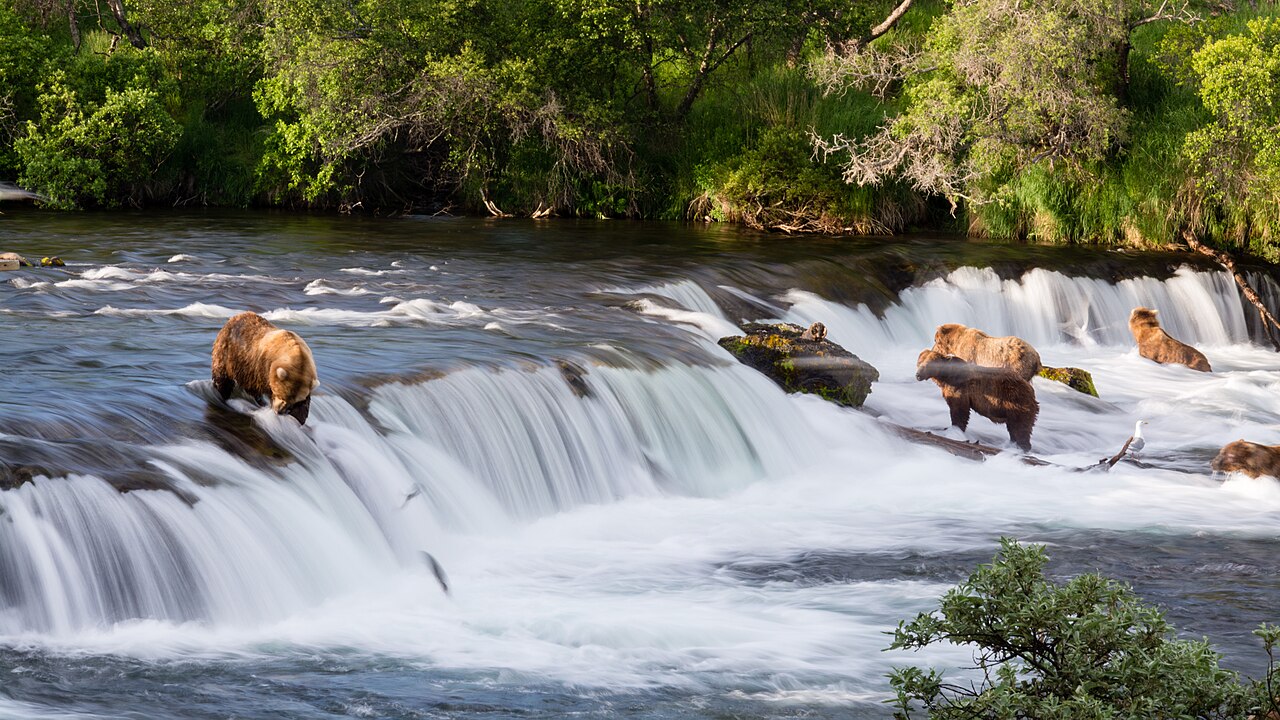
Fat Bear Week started yesterday, and it might be the only contest left in this country that everybody actually trusts.
Here’s how it works, if you somehow missed it. Katmai National Park in Alaska runs a bracket of brown bears who spend all summer and fall stuffing themselves with salmon before winter hibernation. Sixteen bears this year, up from twelve last year, competing on one very specific metric: who got the fattest. The public votes on head-to-head matchups every day through September 29th, and the survivor gets crowned the fattest bear in America. Last year, over 1.7 million votes came in from more than 100 countries, all for a competition about whether a particular brown bear had a bigger gut than his rivals. That bear, Bear 32, nicknamed Chunk, won. He’s back this year defending the title, months removed from a broken jaw, looking like he never missed a meal.
Sit with that number for a second. 1.7 million votes. Over a hundred countries. For a bear beauty pageant, minus the beauty. Nobody rage-quit the app when their bear lost round one. Nobody’s filing a complaint with the FEC. I’d bet money the favorite every year has the best backstory, not just the biggest gut — that’s just how brackets work. And everybody seems fine with that, because the stakes are exactly zero.
That’s the whole trick. We’ve built a culture where agreeing on basically anything — a fact, an election result, a referee’s call, what year it currently is — turns into a fight within four comments. But hand people a bracket full of enormous, waddling salmon-eating animals with names like Bucky and Marshmallow, and somehow a hundred countries’ worth of strangers manage to have an opinion, share it loudly, and then just move on with their lives. Nobody’s accusing Bear 284 of being a deep state operative. Nobody thinks the National Park Service rigged the seeding for ratings.
Part of it is real stakes standing in for fake ones. A bear doesn’t know it’s in a competition. It’s eating salmon because a park ranger this week put it plainly: these bears can go four to six months without eating once they den up for winter, and that’s the actual reason any of this matters to the bear. Everything built on top of that fact — the bracket, the daily voting, the arguing over whether Marshmallow deserved a one-seed — is theater layered onto something real. Compare that to most of the theater we get everywhere else, which is layered onto nothing.
I’m not saying the fix is more bear content and less attention to real issues. That’s not the point, and somebody’s going to read it that way anyway. The point is narrower than that: when the stakes are honest and genuinely small, people show up in huge numbers and act like adults about it. When the stakes get inflated into identity, the same people lose their minds over nothing. Fat Bear Week isn’t an escape from the news. It’s a working demonstration of something the rest of the internet forgot how to do.
Two cents: if 1.7 million strangers from a hundred countries can agree to enjoy a fat bear without accusing each other of treason, the problem was never that people can’t get along. It’s what we keep choosing to fight about.
Photo by Christoph Strässler via Openverse, licensed CC BY-SA 2.0.